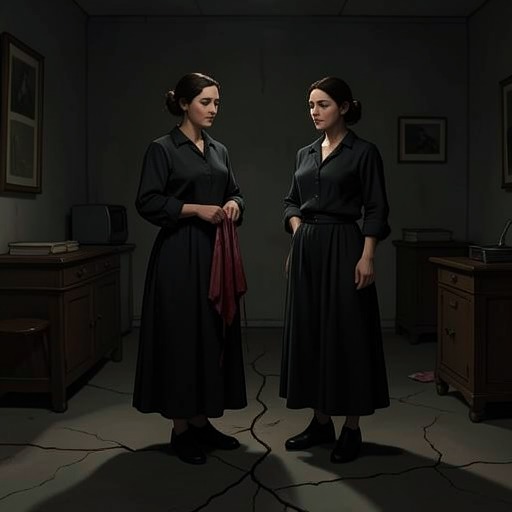
Reba Cordova
Hold TightReba Cordova’s disappearance turns a suburban family’s ordinary plans into the starting point of a murder investigation. A wife and mother last seen on a shopping trip, she is abducted by Nash and killed as part of his attempt to protect Joe Lewiston and destroy evidence of Lewiston’s infidelity. Nash’s effort to make her vanish also separates her case from Marianne’s—until Pietra finally tells investigators where Reba’s body can be found.
Identity and Family
Reba is married to Neil Cordova, a local businessman who owns a chain of barbershops, and they have two young daughters. Neil describes her as a devoted, dependable parent: when she failed to collect their daughter from a special ice-skating class, her absence immediately struck him as unlike her. The family’s ordinary routine gives investigators their first account of where she was expected to go, while its sudden rupture defines the human stakes of the search.
Neil also says Reba had been worried about one daughter’s difficulty with reading. That detail is brief, but it places her attention on the children’s everyday needs rather than on the criminal story that will overtake her. The daughters appear beside Neil at a public appeal for help; he could have attended alone, but chose to stand with them. His visible effort to remain composed cannot conceal his distress, and the family’s presence makes the search public without making the loss any less intimate.
The Errand and Abduction
Reba had gone to Target and planned to spend time at the Palisades Mall in Nyack before driving to Airmont to collect her daughter from skating. Her routine was familiar enough that Neil could give investigators a practical sequence of destinations, including her habit of buying the children’s basic necessities at Target. The account makes her disappearance legible first as a break in a known family schedule: she did not arrive for the pickup, and the explanation that she would normally have provided never came.
At the shopping center, Nash positions his van beside Reba’s green Acura MDX and keeps the van’s side door near the driver’s side of her car. He appears to be occupied with a child seat and watches her approach in the car’s mirror. When Reba uses her remote to open the Acura’s rear hatch and comes close, he exploits that moment to seize control of the situation. The encounter is engineered around the layout of the two vehicles and the appearance of an ordinary task; Reba’s approach brings her within his reach.
Nash restrains her in the van and prevents her from calling out. When she asks what he wants, she has no information about the larger chain of events that has made her a target. The evidence establishes her capture and fear without giving her a part in the criminal scheme. Her story is therefore marked by a stark imbalance: the perpetrators act with a plan, while she is caught in circumstances she could not foresee.
From Missing Person to Investigative Lead
Neil reports Reba missing, and the Livingston Police Department alerts investigators working on the Jane Doe murder. Her description roughly matches the unidentified woman’s, making the possibility of a connection important but not yet proof. Investigators also learn that Reba had expected to go from shopping to her daughter’s class, giving them a last-known itinerary against which to test accounts of her movements.
A witness supplies a more specific lead. He recalls a woman arriving in a green Acura MDX, loading purchases, then getting into a man’s white van without an obvious struggle. Another woman subsequently gets into the Acura, and the two vehicles leave together. The sequence turns the van and Reba’s car into evidence of a coordinated removal rather than a simple unexplained absence. It also distinguishes Reba from the second woman, whose role in driving away in the Acura becomes part of the investigation.
Surveillance footage offers a possible way to identify the vehicles, but not an easy answer. Newark police find a working camera near the Jane Doe murder scene; if a vehicle transported the body there, it could appear in the recording. Investigators anticipate hundreds of vehicles on the tape, so its existence does not by itself solve either case. The witness’s account and the camera footage instead form complementary, incomplete traces: one describes the abduction and the departing cars, while the other may help establish who or what was near the separate murder scene.
Concealment and the Connection to Marianne
Nash makes Reba’s fate harder to investigate by leaving her car in a hotel parking lot. He expects police to interpret that circumstance as evidence that she went there for an illicit meeting and to pursue a possible lover. If no body is found, he reasons, investigators may conclude that she ran away. His plan depends on turning the car from a clue to the abduction into a misleading account of Reba’s private life.
The concealment is also intended to prevent investigators from linking Reba to Marianne. Nash has left Marianne’s body where it can be discovered, but Reba is meant simply to disappear; without a body, he believes there will be no connection between the women. That contrast is deliberate, not incidental. Reba’s absence is the instrument by which Nash hopes to keep the cases separate and to divert attention from his own actions and the evidence he is trying to destroy.
The larger motive emerges when investigators identify the killings as part of Nash’s effort to help his brother-in-law, Joe Lewiston. Nash killed the two women to find and destroy a tape of Lewiston’s infidelity. Reba is thus not presented as a participant in the affair or its cover-up: her murder is an act of violence committed to protect another person and eliminate evidence. Her case reveals the reach of that effort, extending beyond the immediate target of the blackmail to a woman whose disappearance could be exploited as a false story about an unfaithful or absent spouse.
Discovery and Narrative Significance
The search continues amid uncertainty about where Reba might be. When Clarence Morrow, Frank Tremont, and local officers check near Guy Novak’s home, they still entertain the possibility that Guy has taken Reba and is holding her there. As time passes, that hope weakens. The episode shows how an absence permits competing explanations to persist, even as the investigation accumulates evidence of a van, a second driver, and deliberate concealment.
The decisive information comes after Pietra has resisted speaking. With her boyfriend dead and an agreement in place with her lawyer, she breaks her silence after Neil is allowed to talk to her. She tells investigators where Reba’s body will be found. Her disclosure supplies what the search has lacked: not another possibility about Reba’s whereabouts, but a location that can end the uncertainty. Neil and Paul Copeland have spent the period since Reba vanished in conversation; now they face the prospect of sharing the knowledge that their wives are dead.
When Copeland approaches Neil to tell him, Neil begins shaking his head, trying to reject what he can already understand. He then collapses against Copeland and sobs Reba’s name, repeating that it cannot be true and pleading for her return. Copeland holds him without speaking. The scene brings the investigation’s procedural endpoint into direct contact with the family loss that began it: Pietra’s information solves the question of where Reba is, but cannot restore the person Neil and his daughters have been waiting for.
Reba’s narrative role rests on the contrast between the ordinary specificity of her life and the calculated uses to which her absence is put. A shopping trip, a child’s skating lesson, and concern about reading establish the daily pattern from which she is taken. Nash attempts to replace that pattern with a fabricated story of a private rendezvous and a disappearance, while witnesses, recordings, and finally Pietra’s disclosure recover parts of the truth. The investigation can reconstruct the means and motive of her death; the final encounter between Neil and Copeland makes clear what such reconstruction cannot undo.